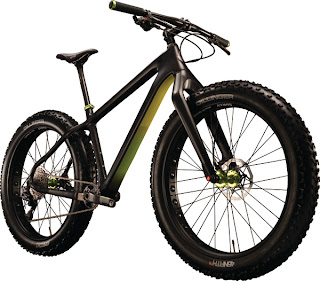
Spring is the perfect time to adopt a fad crash-diet or "cleanse" to shed those unsightly winter pounds from around one's midsection. But since I have grown quite comfortable with my steady intake of dark beer, pizza, and ice cream, I won't be chugging
lemon juice-cayenne pepper-maple syrup anytime soon. Instead, like a controlling boyfriend, my focus has turned to encouraging rapid weightloss from the object of my affection, the Surly Moonlander.
My Moonlander rolled off the showroom floor at a portly 38+ pounds; and after getting
burned by the fat-bike racerboy set on their sub-30 pound titanium Fatbacks this winter, the seeds of carbon-envy and
weight-weenie dogma were planted. A cheapo digital scale from Costco and a few hundred dollars burning a hole in my pocket was all I needed to begin the project.
The internet will tell you that one pound of rotating mass is equivalent to two pounds of static mass, so I first turned my attention to the Clownshoes.
I purged the heavy rubber Surly rim strips in place of light-weight and fashion forward orange ribbon (instantly saving 200+ grams), and opted for a pair of standard 26" downhill tubes cutting another several hundred grams off the thick Surly tubes that are better suited for a motorcycle.
Many fat-bikers are hot for
tubeless setups these days, but seeing Stans fluid cause an instant freezer burn after spewing into a buddy's skin at -20 F this winter (Stans won't freeze) when his tubeless tire broke the bead seat, I am disinclined to accept that risk for the inherent benefits of a tubeless fat-bike (maybe when I move back to the desert).
A titanium XTR cassette and Formula floating rotor complete the rear weight loss plan and add an additional bling factor.
Next was the cockpit: Carbon handlebars are (in my opinion) the top 3 best aftermarket additions to a fat bike. In addition to saving weight and looking sexy, carbon handlebars do not conduct thermal energy in the same way as their metallic counterparts. Carbon's poor thermal conductivity results in warmer hands, as the bar will not hold the cold of the frigid winter air, nor will it transmit the cold of your exposed handlebar midsection into your grip area. Your hands maintain a comfortable temperature for longer.
Thermal Conductivity - k - W/(m.K) of Aluminum rates at 205 k, whereas Carbon and Fiberglass rate at 1.7 k and 0.04 k respectively (actual thermal conductivity of carbon-fiber in bicycle handlebars will vary based on composite resins used, but assume the ballpark between 0.04 k and 1.7 k) This mindset of considering the impact of thermal conductivity of parts can be applied to peddles too, which was the driving force behind my decision to ditch my aluminium platforms for a set of cheap nylon (0.25 k) BMX peddles, and my feet stay much warmer now.
Here is a table for geeking out on. Read more
here,
here, or
here. Looking in to this further would make for a great high-school science project; but all I know is my hands feel better on carbon and that makes me a believer.
| Thermal Conductivity - k - W/(m.K) |
| Material/Substance | Temperature - oC |
| 25 | 125 | 225 |
| Acetone | 0.16 | | |
| Acetylene (gas) | 0.018 | | |
| Acrylic | 0.2 | | |
| Air, athmosphere (gas) | 0.024 | | |
| Alcohol | 0.17 | | |
| Aluminum | 205 | 215 | 250 |
| Aluminum Oxide | 30 | | |
| Ammonia (gas) | 0.022 | | |
| Antimony | 18.5 | | |
| Apple (85.6% moisture) | 0.39 | | |
| Argon (gas) | 0.016 | | |
| Asbestos-cement board | 0.744 | | |
| Asbestos-cement sheets | 0.166 | | |
| Asbestos-cement | 2.07 | | |
| Asbestos, loosely packed | 0.15 | | |
| Asbestos mill board | 0.14 | | |
| Asphalt | 0.75 | | |
| Balsa wood | 0.048 | | |
| Bitumen | 0.17 | | |
| Bitumen/felt layers | 0.5 | | |
| Beef, lean (78.9 % moisture) | 0.43 - 0.48 | | |
| Benzene | 0.16 | | |
| Beryllium | 218 | | |
| Bitumen | 0.17 | | |
| Blast furnace gas (gas) | 0.02 | | |
| Brass | 109 | | |
| Breeze block | 0.10 - 0.20 | | |
| Brick dense | 1.31 | | |
| Brickwork, common | 0.6 -1.0 | | |
| Brickwork, dense | 1.6 | | |
| Butter (15% moisture content) | 0.20 | | |
| Cadmium | 92 | | |
| Calcium silicate | 0.05 | | |
| Carbon | 1.7 | | |
| Carbon dioxide (gas) | 0.0146 | | |
| Cement, portland | 0.29 | | |
| Cement, mortar | 1.73 | | |
| Chalk | 0. 09 | | |
| Chlorine (gas) | 0.0081 | | |
| Chrome Nickel Steel (18% Cr, 8 % Ni) | 16.3 | | |
| Clay, dry to moist | 0.15 - 1.8 | | |
| Clay, saturated | 0.6 - 2.5 | | |
| Cobalt | 69 | | |
| Cod (83% moisture content) | 0.54 | | |
| Concrete, lightweight | 0.1 - 0.3 | | |
| Concrete, medium | 0.4 - 0.7 | | |
| Concrete, dense | 1.0 - 1.8 | | |
| Concrete, stone | 1.7 | | |
| Constantan | 22 | | |
| Copper | 401 | 400 | 398 |
| Corian (ceramic filled) | 1.06 | | |
| Corkboard | 0.043 | | |
| Cork, regranulated | 0.044 | | |
| Cork | 0.07 | | |
| Cotton wool | 0.029 | | |
| Carbon Steel | 54 | 51 | 47 |
| Cotton Wool insulation | 0.029 | | |
| Diatomaceous earth (Sil-o-cel) | 0.06 | | |
| Diatomite | 0.12 | | |
| Earth, dry | 1.5 | | |
| Engine Oil | 0.15 | | |
| Ether | 0.14 | | |
| Ethylene (gas) | 0.017 | | |
| Epoxy | 0.35 | | |
| Ethylene glycol | 0.25 | | |
| Felt insulation | 0.04 | | |
| Fibreglass | 0.04 | | |
| Fibre insulating board | 0.048 | | |
| Fibre hardboard | 0.2 | | |
| Fireclay brick 500oC | 1.4 | | |
| Foam glass | 0.045 | | |
| Freon 12 (gas) | 0.073 | | |
| Freon (liquid) | 0.07 | | |
| Gasoline | 0.15 | | |
| Glass | 1.05 | | |
| Glass, Pearls, dry | 0.18 | | |
| Glass, Pearls, saturated | 0.76 | | |
| Glass, window | 0.96 | | |
| Glass, wool Insulation | 0.04 | | |
| Glycerol | 0.28 | | |
| Gold | 310 | 312 | 310 |
| Granite | 1.7 - 4.0 | | |
| Gravel | 0.7 | | |
| Gypsum board | 0.17 | | |
| Hairfelt | 0.05 | | |
| Hardboard high density | 0.15 | | |
| Hardwoods (oak, maple..) | 0.16 | | |
| Helium (gas) | 0.142 | | |
| Honey (12.6% moisture content) | 0.5 | | |
| Hydrochlor acid (gas) | 0.013 | | |
| Hydrogen (gas) | 0.168 | | |
| Hydrogen sulfide (gas) | 0.013 | | |
| Ice (0oC, 32oF) | 2.18 | | |
| Insulation materials | 0.035 - 0.16 | | |
| Iridium | 147 | | |
| Iron | 80 | 68 | 60 |
| Iron, wrought | 59 | | |
| Iron, cast | 55 | | |
| Kapok insulation | 0.034 | | |
| Kerosene | 0.15 | | |
| Krypton (gas) | 0.0088 | | |
| Lead Pb | 35 | | |
| Leather, dry | 0.14 | | |
| Limestone | 1.26 - 1.33 | | |
| Magnesia insulation (85%) | 0.07 | | |
| Magnesite | 4.15 | | |
| Magnesium | 156 | | |
| Marble | 2.08 - 2.94 | | |
| Mercury | 8 | | |
| Methane (gas) | 0.030 | | |
| Methanol | 0.21 | | |
| Mica | 0.71 | | |
| Milk | 0.53 | | |
| Mineral wool insulation materials, wool blankets .. | 0.04 | | |
| Molybdenum | 138 | | |
| Monel | 26 | | |
| Neon (gas) | 0.046 | | |
| Nickel | 91 | | |
| Nitrogen (gas) | 0.024 | | |
| Nylon 6 | 0.25 | | |
| Oil, machine lubricating SAE 50 | 0.15 | | |
| Olive oil | 0.17 | | |
| Oxygen (gas) | 0.024 | | |
| Paper | 0.05 | | |
| Paraffin Wax | 0.25 | | |
| Perlite, atmospheric pressure | 0.031 | | |
| Perlite, vacuum | 0.00137 | | |
| Plaster light | 0.2 | | |
| Plaster, metal lath | 0.47 | | |
| Plaster, sand | 0.71 | | |
| Plaster, wood lath | 0.28 | | |
| Plastics, foamed (insulation materials) | 0.03 | | |
| Platinum | 70 | 71 | 72 |
| Plywood | 0.13 | | |
| Polyethylene HD | 0.42 - 0.51 | | |
| Polypropylene | 0.1 - 0.22 | | |
| Polystyrene, expanded | 0.03 | | |
| Polystyrol | 0.043 | | |
| Polyurethane foam | 0.03 | | |
| Porcelain | 1.5 | | |
| Potato, raw flesh | 0.55 | | |
| Propane (gas) | 0.015 | | |
| PTFE | 0.25 | | |
| PVC | 0.19 | | |
| Pyrex glass | 1.005 | | |
| Quartz mineral | 3 | | |
| Rock, solid | 2 - 7 | | |
| Rock, porous volcanic (Tuff) | 0.5 - 2.5 | | |
| Rock Wool insulation | 0.045 | | |
| Rubber, natural | 0.13 | | |
| Salmon (73% moisture content) | 0.50 | | |
| Sand, dry | 0.15 - 0.25 | | |
| Sand, moist | 0.25 - 2 | | |
| Sand, saturated | 2 - 4 | | |
| Sandstone | 1.7 | | |
| Sawdust | 0.08 | | |
| Sheeps wool | 0.039 | | |
| Silica aerogel | 0.02 | | |
| Silicone oil | 0.1 | | |
| Silver | 429 | | |
| Slag wool | 0.042 | | |
| Slate | 2.01 | | |
| Snow (temp < 0oC) | 0.05 - 0.25 | | |
| Sodium | 84 | | |
| Softwoods (fir, pine ..) | 0.12 | | |
| Soil, with organic matter | 0.15 - 2 | | |
| Soil, saturated | 0.6 - 4 | | |
| Steel, Carbon 1% | 43 | | |
| Stainless Steel | 16 | 17 | 19 |
| Straw slab insulation, compressed | 0.09 | | |
| Styrofoam | 0.033 | | |
| Sulfur dioxide (gas) | 0.0086 | | |
| Sugars | 0.087 - 0.22 | | |
| Timber | 0.14 | | |
| Tin Sn | 67 | | |
| Zinc Zn | 116 | | |
| Urethane foam | 0.021 | | |
| Vermiculite | 0.058 | | |
| Vinyl ester | 0.25 | | |
| Water | 0.58 | | |
| Water, vapor (steam) | | 0.016 | |
| Wheat flour | 0.45 | | |
| Wood across the grain, white pine | 0.12 | | |
| Wood across the grain, balsa | 0.055 | | |
| Wood across the grain, yellow pine, timber | 0.147 | | |
| Wood, oak | 0.17 | | |
| Wool, felt | 0.07 | | |
| Wood wool, slab | 0.1 - 0.15 | | |
| Xenon (gas) | 0.0051 | | |
- 1 W/(m.K) = 1 W/(m.oC) = 0.85984 kcal/(h.m.oC) = 0.5779 Btu/(ft.h.oF) = 0.048 Btu/(in.h.oF)
In my quest for further enlightenment I also ditched several other attachments: front rack, bar ends, seat-post bag, frame bag, heavy all-mountain saddle, and my trusty King Cage Mud Flask, because as a weight weenie disciple I am more concerned with
performance than utility.
All in all, with carbon seatpost, ti-railed saddle, fomula R1 brakes, and all other aforementioned goodies, the Moonie weighed in at a respectable 32.32 lbs.
I had lost roughly 5 lbs, but when factoring in the 2 lbs of rolling weight = 4 lbs of dead weight, gained about 9 lbs worth of
performance .